Chile's Route 7: A tough, lonely drive to the end of the world

 Alamy
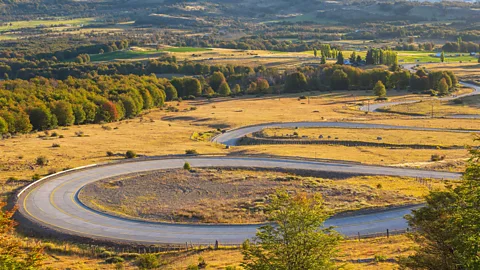
AlamyChile's Carretera Austral remains one of the world's most remote and spectacular road trips, where every kilometre tests your resolve and rewards your persistence.
The ferry from Hornopirén lurched through dark-blue waters as I watched the Chilean mainland disappear into mist. Ahead lay the tiny settlement of Caleta Gonzalo and the true beginning of the Carretera Austral – Chile's legendary Route 7.
Built by the Chilean Army in the 1970s, this partially paved highway stretches 1,240km (771 miles) from Puerto Montt to Villa O'Higgins, connecting once-isolated Patagonian communities through some of the most unforgiving terrain on Earth. The road is so remote and challenging that driving it feels like a journey to the edge of civilisation.
A road carved from wilderness
Building the highway required decades of blasting through solid granite, bridging raging torrents and creating a pathway where none should exist. Even today, sections remain unpaved, and my small rental SUV often felt like it was being rattled to the last nut and bolt. Yet the scenery compensated a hundredfold: ancient forests of alerce trees, dramatic Chilean fjords, the snow-capped Andes and turquoise-blue lakes fed by glaciers.
I had planned to cover the 630km (391 miles) between Chaiten and Bahia Murta, my next stop, in just one day due to time constraints. It's a long drive by any standards, but on Patagonia's loneliest road, it quickly became a challenge.
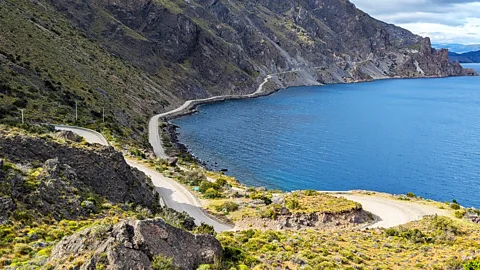
At a tiny roadside café, where I stopped for some beef asado, I chatted with some local truck drivers. Once they'd learned about my Bahia Murta ambitions, the drivers couldn't hide their knowing grins. I soon understood why locals stick to sturdy, four-wheel drive pickup trucks. Climbing loose gravel switchbacks that snaked ever upward over a mountain pass required all my focus and skill. I gripped the wheel, whispering prayers to the anti-lock breaking system.
 Egle Gerulaityte
Past Puyuhuapi, known for its natural hot springs, the Carretera evened out with a few stretches of pavement as I neared Coyhaique, the last bigger town on the route. After this, the towns were small settlements with basic grocery stores that served as post offices, cafes, fuel stations and fishing stores all in one. The road smoothed briefly before plunging again into gravel tracks cutting across dark ancient woods and hugging white-water river shores with the towering peaks of the Andes looming on both sides. By the time I rolled into Bahía Murta at midnight, I understood the drivers' smiles.
Where climate change reveals ancient wonders
Bahia Murta is about halfway along the Carretera Austral route, and this is where the road skirts the shores of Lake General Carrera, South America's second-largest lake. From here I detoured to Puerto Sanchez and the stunning Marble Caves, a natural wonder only recently revealed more fully by climate change.
Plan your trip:
December-March offers the best weather, though even summer can bring unpredictable storms. A 4x4 vehicle is recommended, but careful drivers in regular cars can manage most sections.
Plan 7-10 days for the complete journey, allowing time for weather delays, mechanical issues and the simple reality that rushing defeats the purpose of taking one of the world's last great road trips. Fuel stations are strategically placed but far apart; the 100km (62 mile) stretch between Cochrane and Villa O'Higgins has no services.
Here I met Valeria Leiva, a local woman whose family story intertwines with the caves' recent emergence as a tourist destination. "My grandfather, Don Cirilo Herrera Aguilera, arrived here in 1948 when he was just eight years old," she told me as we prepared for a boat tour across impossibly blue waters. "He was one of the first to settle in this area."
What Don Cirilo couldn't have predicted was that his decision to buy an archipelago of 14 islands for sheep farming would eventually become home to one of the world's most incredible natural wonders.
"Everything changed when the lake levels began to drop," Leiva explained. "Because of global warming, the glaciers are retreating and there's less snow, which is why the Marble Caves have begun to reveal themselves over the past 40 years."
 Egle Gerulaityte
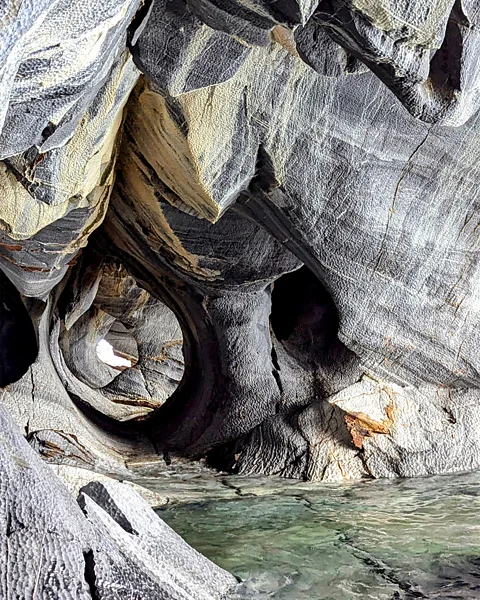
The caves themselves look ethereal: natural rock formations with curved walls covered in swirling mineral patterns, flooded with turquoise waters that fill the caverns with blue light. Formed around 10,000 to 15,000 years ago as lake water slowly dissolved minerals in the rocks, they embody both natural beauty and the effects of environmental change.
Where to stop:
Key stops directly on the route include Chaitén (ferry access), Villa Santa Lucía, Coyhaique (major supply point) and Cochrane (last major town before Villa O'Higgins).
Worthwhile detours include the Marble Caves (half-day addition), Queulat National Park with its hanging glacier (two-hour detour) and the hot springs at Puyuhuapi (directly on route).
I relished the silence and solitude, the gentle ripples in the impossibly blue Lago General Carrera and the warmth of the small community of Puerto Sanchez. Suddenly, I could see myself going offline, off grid and into the wild.
Still, the road was calling.
Back on Route 7, the Carretera settled into its own rhythm. I finally accepted that my carefully planned schedule had no business here in Patagonia where a change in weather, a landslide, a delayed ferry could mean a pause of an entire day or two.
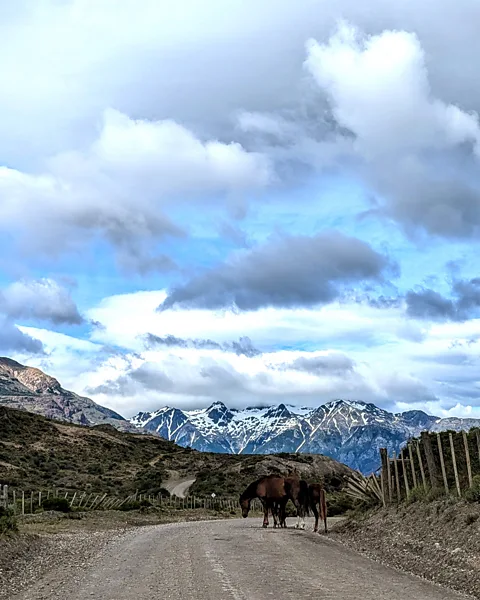
Slowing for two gauchos on horseback moving cattle across the road, I turned the engine off: both to show respect and not spook the horses, but also because Chilean cowboys are a sight to behold. Dressed in rugged leather chaps, woollen sweaters and the iconic berets, wielding long whips and masterfully directing their horses, the gauchos ran a herd of at least 20 cattle across the road in a thundering chaos of flying hooves, horns and dust. Then, as suddenly as they appeared, they were gone.
 Egle Gerulaityte
I started the engine again, crawling carefully forward and taking in the landscape of granite walls, glacier-covered Andes and the lush greenery coloured purple, pink, and yellow by blooming wildflowers.
The final push to World's End
The last section from Cochrane to Villa O'Higgins is both the most challenging and spectacular. The road narrows to a single lane carved into cliffs with terrifying drop-offs, but by now, I had learned that slow and steady is the way to go.
Ends of the Earth
Sometimes the journey is the adventure. In Ends of the Earth, we revel in far-flung destinations that are well worth the trek.
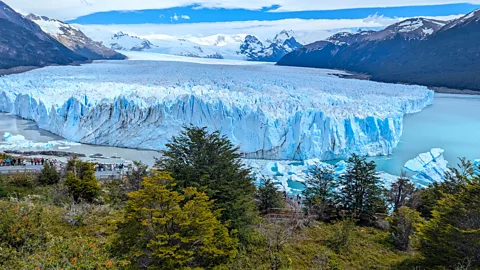
Villa O'Higgins itself felt like an outpost at civilisation's edge. This tiny frontier town of fewer than 500 residents sits in a valley surrounded by glaciated peaks, where the road literally runs out of land to cross. Beyond lies the Southern Patagonian Ice Field – the third-largest ice field in the world after Antarctica and Greenland.
The town's single main street was lined with weathered wooden buildings. Here, locals wave at every passing vehicle. One morning I woke to a beat-up red pickup announcing "¡Arándanos, cerezas" through a loudspeaker: blueberries and cherries, sold fresh from the back. Tempted, I waved the farmer down and bought the sweetest cherries I've ever tasted.
 Egle Gerulaityte
Villa O'Higgins is where the road ends – not because engineers ran out of steam, but because the Earth itself is too wild to tame. From here, travellers can take boat trips to glaciers or set out on multi-day hikes – but for me, it was time to turn north.
More like this:
• The ski resort Olympians flock to each summer
• A road trip to the edge of the Earth
• The ancient mummies older than Egypt's
It's bittersweet, reaching the end of the Carretera Austral. The road represents something increasingly rare: a journey where the destination matters less than the getting there. It's a road that strips away modern travel's conveniences and forces you to engage with landscape, weather and your own limitations.
--
If you liked this story, sign up for The Essential List newsletter – a handpicked selection of features, videos and can't-miss news, delivered to your inbox twice a week.
For more Travel stories from the BBC, follow us on Facebook and Instagram.