'It feels like entering a folktale': 10 of the world's most spectacular tree houses

Treetop living is not just for kids. These architect-designed, "nest-like" dwellings – created in forests all over the world – are the ultimate sky-high retreats from urban living.
In his encyclopaedia Natural History (c. AD77), Pliny the Elder describes "a tree so worthy to be deemed a marvel" that the Roman statesman Licinius Mucianus held a banquet in it. He slept the night in its branches, "receiving more delight from the agreeable sound of the rain dropping through the foliage than gleaming marble, painted decorations or gilded panelling could have afforded". Treetop living has long captured our imagination, in Johann David Wyss's fictional tale of the shipwrecked Swiss Family Robinson (1812), who constructed a tree house on a desert island, and the Guingettes de Robinson that first appeared in 1848: arboreal dining experiences inspired by Wyss's novel that had style-conscious Parisians ascending to thatched cabins in the trees.
Today, the tree house has evolved into something new. "Since the late 1990s, architects have been rediscovering this ancient, seemingly whimsical typology – not for whimsy's sake, but for sustainability, intimacy, and a renewed dialogue with nature," writes Florian Seabeck in a new book, Modern Tree Houses, published by Taschen. The book showcases the creations of a new generation of environmentally-minded architects, whose contrasting approaches to treetop living are united by a shared desire to reconnect with the natural world.
According to Seabeck, tree houses are "at once symbols of escape and agents of return – part childhood daydream, part ecological manifesto… There's something about rising above the ground – however slightly – that shifts our perspective. In a world engineered for more, they quietly offer less – and, in doing so, suggest it might be enough." Here are 10 modern tree houses from the book.
 Massimo Crivellari
1. Pigna by Beltrame Studio – Malborghetto, Italy (2017)
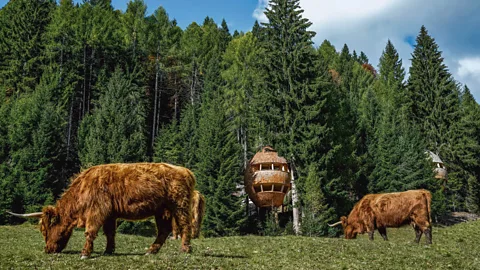
Perched at an elevation of 1,200 metres, and commanding stunning views across the Italian Alps, are two tree houses shaped like oversized pine cones. Each is carved in spruce wood with a larch-shingled shell, using biomimicry (imitating nature) to merge with its spectacular surroundings. "Climbing into these wooden husks feels like entering a folktale," writes Seabeck, and suggests "the sense of being cradled". It's a mistake, however, to dismiss such designs as child's play. "These are not childhood hideouts," he stresses. "They are vessels for reflection."
 Tom Klocker
2. Bert by Studio Precht – Turnau, Austria (2021)
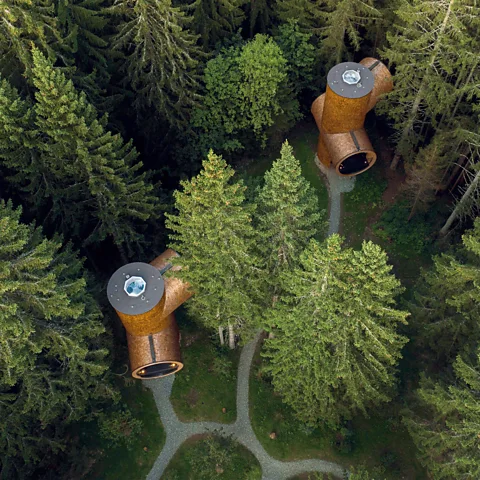
Bert is "more of a tree than a house", says Chris Precht, who founded Studio Precht with his wife, Fei, in 2018. Shaped like a trunk sprouting branches, Bert's modular concept makes it quick to assemble and easy to adapt or extend according to a client's changing needs. To minimise its impact on the environment, the elevated design occupies just two square metres of the forest floor and is equipped with a composting toilet and solar panels. For Fei, treetop living offers a sense of perspective. "When you walk into a forest, you're no longer the centre of the universe but only a small part of a much greater sequence of events," she says in the book.
 Zhu Ziye
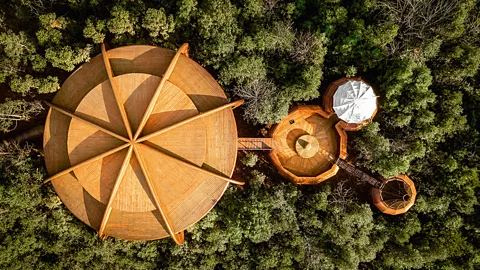
3. Qiyun Mountain UFO by Atelier Design Continuum – Qiyun Mountain, China (2022)
In 2022, an Unidentified Forest Object, shaped like a flying saucer, settled in Mount Qiyun National Park, its wraparound porch providing 360-degree views of the pine forest and mountains beyond. The fun, futuristic design, clad in locally sourced red cedar to minimise its environmental impact, was created with families in mind. Three linked structures, satellites to the building's hub, supply additional amenities. One houses a bar, another a barbecue, and a third, accessed by a rope tunnel, offers a bouncy moonwalk on a star-shaped trampoline.
 Santiago Baravalle
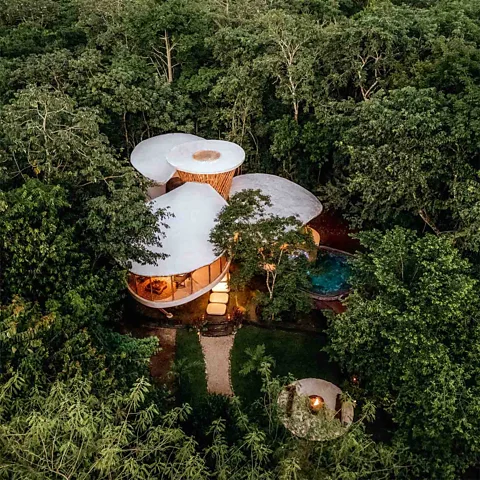
4. The Trillium by Awakening Experiencias – Yucatán, Mexico (2024)
Treetop living need not preclude the occasional luxury. The Trillium, for example, has its own pool and jacuzzi. The three-petalled flower that inspired its name and form is also a traditional symbol of the harmony of nature. Indeed, as Seabeck remarks, the structure seems "to have grown naturally from the landscape rather than being constructed". Hand-crafted using traditional techniques, it incorporates local materials such as volcanic stone and the Maya resin "chukum", a natural plaster. "Nature does not necessarily mean it's untouched by humanity," says Awakening's co-founder Martin Loeffler in a video introducing the Trillium concept. "It can actually be complemented by humanity, and we can integrate with nature the best way possible."
 Matts Engfors
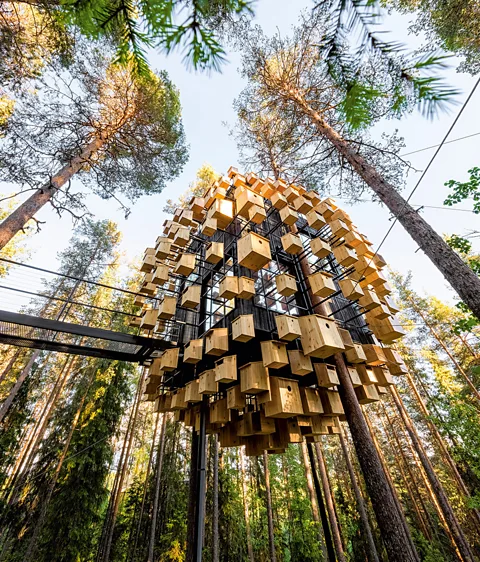
5. Biosphere by Bjarke Ingels Group, BIG – Harads, Sweden (2022)
For some tree house architects, a closeness with nature means actively inviting it in. Appearing to float in the forest canopy, the glassy Biosphere is studded with 350 birdhouses, attracting not just birds, but bats and bees, too. The structure is part of the Treehotel, a clutch of eight different designs in Swedish Lapland. It was created in consultation with an ornithologist in response to birds' habitat loss. Human comforts are also well catered for, with fun features such as a sauna and walkable rooftop.
 Carlos Chavarría
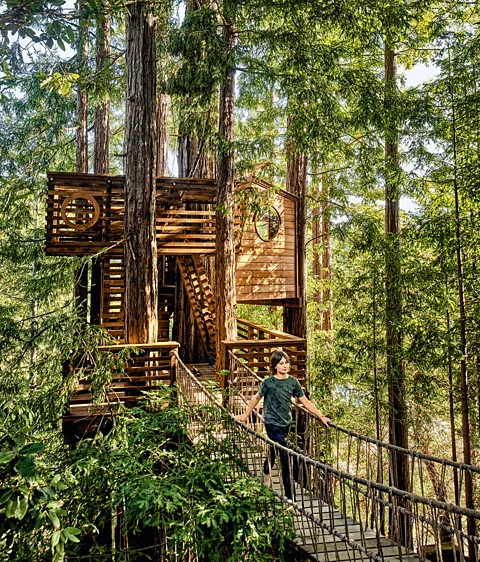
6. Loma Mar Tree House by Jay Nelson Studio – California, USA (2020)
With its handcrafted furniture, portholes and periscope, the tree house that Jay Nelson designed for his children in a redwood forest in the Santa Cruz Mountains soon became the envy of adults. A second room was added so the parents could join in the fun, but there was still competition for the huge rope hammock. Tree houses are places where young people can "assert a kind of provisional independence", notes the book, and are popular in the Scout movement. "For many adults, the tree house continues to offer an echo of that formative freedom."
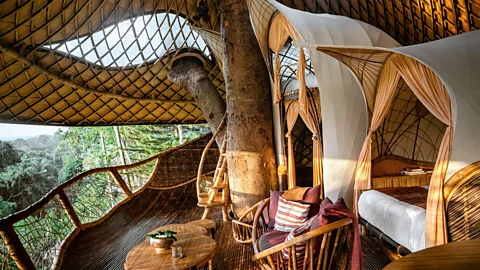 Bambu Indah
7. Tree house at Bambu Indah by Ibuku – Bali, Indonesia (2021)
In the rainforest of Bali's Ubud District, surrounded by rice paddies, is a tree house shaped like a cluster of toadstools. The open-air structure, including its walls and floors, is woven almost entirely from bamboo, the planet's fastest-growing plant. Skewered by the banyan trees in which it is held, the basket-like structure merges almost seamlessly into the jungle. The sharp angles of modern architecture have vanished, replaced by nature's gentle curves. "The floors curl upward into sweeping walls, while the roof floats above the canopy," writes Seabeck, who describes it as "a nest-like space with no defined edges".
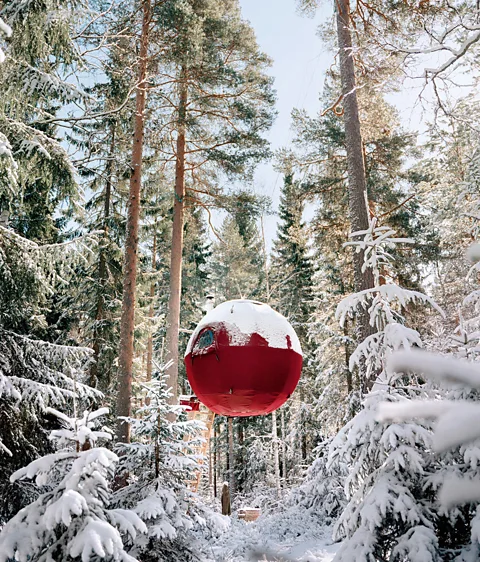 Viggo Lundgerg
8. Tree Tent by Tree Tents International – Dalarna, Sweden (2016)
The giant red bauble suspended from pines at Näsets Marcusgård, a former farm, is not a Christmas decoration but a "tree tent" made of an aluminium and plywood frame, wrapped up in a waterproof canvas. The customisable tree house, says Tree Tents International's founder and design director Jason Thawley, aims "to connect people to the outdoors through design" and "works with nature rather than building against or around it". Willem Terstegen, the co-owner of Näsets Marcusgård, tells the BBC: "Being among the trees offers a small shift that feels immense. The world looks softer, time slows down, and even silence feels alive."
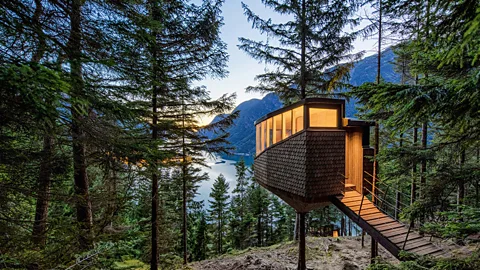 Woodnest/ Sindre Ellingsen
9. Woodnest by Helen & Hard – Odda, Norway (2020-2023)
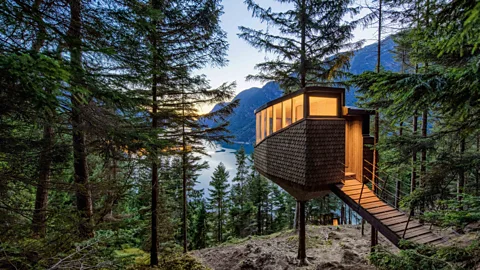
For some designers and daydreamers, the tree house is all about romance. Kjartan Arno wanted to propose to his girlfriend Sally, and resolved to build a tree house in which to do so. The simple 10m-high structure, accessed by a hair-raising climb through its branches, became a vessel of happy memories, leading the couple to team up with architects Helen & Hard to create a more ambitious retreat: Woodnest. Hugging the narrow trunk of a pine tree so that it appears to stand on one leg – and accessible this time by a bridge – Woodnest sleeps four, and features a bath with breathtaking views of the Hardanger fjord.
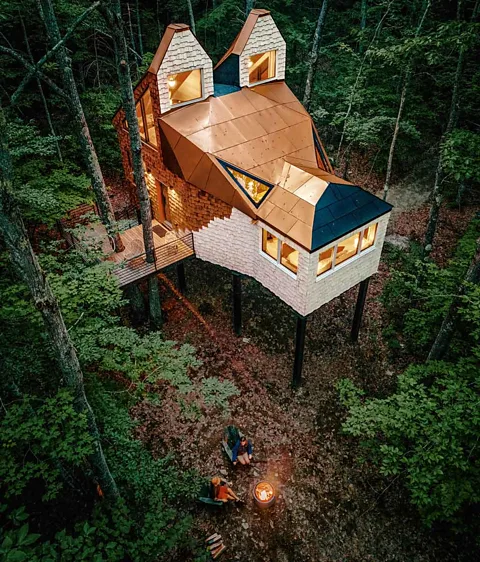 Chris and Pam Daniele
10. The Copper Fox by Heidi Richards and Nicholas Cote – Maine, USA (2023)
"Ever since I can remember, I've always wanted to build my own tree house," Heidi Richards tells the BBC. "We had a big tree in our backyard – that I was constantly in – always trying to climb higher and higher." She used to drag "found objects and leftover building material" up into its branches.
More like this:
• Eight quick fixes to revitalise your home
• Eight paint colours that can transform your home
• Eight of the UK's cosiest cottages
The Copper Fox, designed and constructed with her husband Nicholas using mostly locally sourced logs and salvage, was intended to feel "like a sculpture on a large scale", Richards explains. Its snout is the main sleeping area, while the pointed ears form a cosy mezzanine accessed by a ladder. "I think being in a tree house makes you feel like a kid on an adventure," she says. "When you are experiencing treetop living, anything feels possible."
Modern Tree Houses is published by TASCHEN.
--
If you liked this story, sign up for The Essential List newsletter – a handpicked selection of features, videos and can't-miss news, delivered to your inbox twice a week.
For more Culture stories from the BBC, follow us on Facebook and Instagram.