Summary

  • Spain's PM Pedro Sánchez vows an investigation will uncover the cause of a high-speed train crash that killed at least 39 people as the country declares three days of mourning

  • A Madrid-bound train derailed and crossed over to the opposite tracks, colliding with an oncoming train in Adamuz on Sunday - here's what we know about the crash

  • A passenger on the train told local media he felt a jolt and had "the feeling that the whole train was going to fall apart"

  • Most of those killed and injured were in the front carriages of the second train, which was travelling south from Madrid to Huelva

  • Transport Minister Oscar Puente says the crash happened on a straight part of the track, calling it "extremely strange". Meanwhile rail company Iryo says the "relatively new" Madrid train, built in 2022, was inspected four days ago

  • Have you been affected by the collision? If it's safe to do so, get in touch via email, external or WhatsApp +44 7756 165803, external

Media caption,

Spain train crash survivors describe 'absolutely terrifying' scene

  1. Flags at half-mast and moments of silence as Spain mournspublished at 11:40 GMT
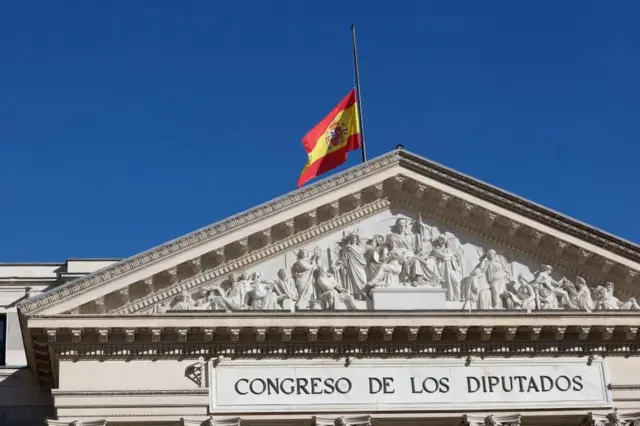
    The Spanish flag flies at half-mast at the Lower House in Madrid, SpainImage source, EPA
    Image caption,

    Flags are being flown at half-mast across Spain, including at the lower house of parliament, the Congress of Deputies (pictured)
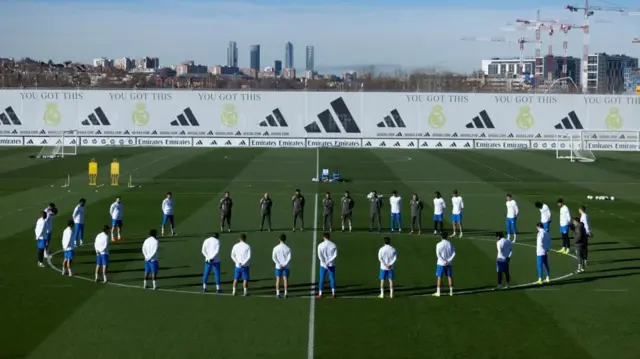
    Football players stand in a circle on a training pitch with the Madrid skyline in the backgroundImage source, EPA
    Image caption,

    Moments of silence are also being observed. Real Madrid players remembered the crash victims before training
  2. Train crash is a 'catastrophe', says regional leaderpublished at 11:26 GMT

    The president of the Andalusian regional government, Juanma Moreno, has called the crash a "catastrophe".

    "These kinds of accidents are surprising. The crash was very, very serious. A train carries society - grandparents, children, pregnant women... It's a catastrophe," he told Spanish news broadcaster, La Sexta.

    At least 39 people have been killed and dozens more injured in the high-speed train collision in southern Spain.

  3. Condolences pour in from across Europepublished at 10:59 GMT

    Condolences have poured in for the victims and those injured in the high-speed train crash since Sunday evening.

    Addressing the people of Spain, French President Emmanuel Macron says: "France stands by your side."

    Italy's Prime Minister echoed this message. "Italy stands close to Spain in its grief for this tragedy."

    Ukraine's Foreign Minister Andrii Sybiha addresses the Spanish people, telling them to "stay strong", adding that Ukraine "shared [their] pain".

  4. Passenger describes 'horrifying' moment of collisionpublished at 10:46 GMT

    Lucas Meriako, a passenger on the high-speed Madrid-bound train that derailed and collided with another oncoming train, says the experience was "horrifying".

    "We were in carriage five and we started to feel some banging on the track, nothing unusual," he tells Spanish news broadcaster, La Sexta Noticias.

    Then, the banging became louder, he says.

    "Another train passed us and everything started vibrating. There was a jolt behind us and the feeling that the whole train was going to fall apart," he describes.

    Meriako says that the impact of the collision shattered the train's windows, displaced luggage and threw people on to the floor. People then started breaking windows to get out.

  5. Crash did not happen due to excessive speed or human error, says train operator headpublished at 10:33 GMT

    The president of state-funded firm Renfe, which operated one of the trains involved in the collision, says he has "discarded" the possibility that the incident happened due to excessive speed or human error.

    Speaking to RNE, Spain's national radio, Álvaro Fernández Heredia says human error is "practically discarded" as even if a mistake had been made, a system within the train would have fixed it.

    He adds that both trains were under the 250km/h (155mph) maximum speed on the stretch of track where the crash happened, and that it took place on a straight section of the track rather than a curve.

    Fernández Heredia points to either a mechanical fault or infrastructure issue as a more probable cause, but emphasizes that it's "very complicated" to arrive at a conclusion so soon after the incident.

  6. Spain's PM to visit train crash sitepublished at 10:23 GMT

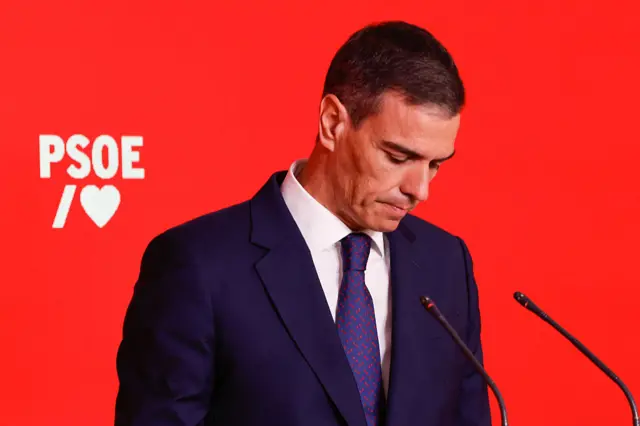
    Close up shot of Pedro Sánchez looking down as he speaks into a microphone at an event. He is wearing a dark suit, white shirt, and purple purple and red tie.Image source, AFP
    Image caption,

    File photo of Spanish Prime Minister Pedro Sánchez from June 2025

    Spanish Prime Minister Pedro Sánchez will visit the scene of the crash in southern Spain later on Monday, local media report.

    Reports quote a statement by the prime minister's office saying the aim of his visit is "to get first-hand information" on Sunday's crash.

    Sánchez has cancelled his events schedule for Monday following the deadly incident, and is also reported to have pulled out of his plans to travel to Davos on Tuesday to attend the World Economic Forum.

  7. Crash on new section of line 'extremely strange', minister sayspublished at 10:03 GMT

    Spain's Transport Minister Óscar Puente tells reporters the crash took place on a straight section of track that had been completely renovated last May after major investment.

    The first train to derail was also "practically new", he says.

    This made the accident "extremely strange" and "very difficult to explain". Rail experts are "very surprised by this accident", he adds.

    He says it will take at least a month for the results of the investigation to be released.

  8. Train that first derailed inspected four days ago, rail company sayspublished at 09:56 GMT

    The company that operated the train that first derailed while travelling between Málaga and Madrid on Sunday night says the locomotive was inspected just four days ago.

    In a statement quoted by AFP news agency, Iryo says the train was built in 2022 and so was relatively new.

    It "veered onto the adjacent track for still unknown reasons", the company says.

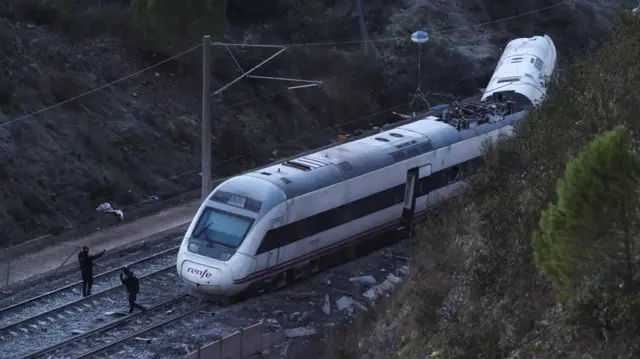
    Carriages on the Iryo-oeprated train derailed and crossed over to the opposite tracks in Adamuz on Sunday night, colliding with an oncoming train travelling south between Madrid and Huelva.

  9. What we know - and don't know - about the crashpublished at 09:42 GMT

    Members of the Spanish Civil Guard work next to one of the trains involved in the crashImage source, Reuters
    Image caption,

    Around 100 people were believed to have been onboard this train, operated by state-funded company Renfe

    Details are still emerging from last night's train crash, with emergency services still working to establish the facts. Here's what we know so far:

    • At least 39 people have been killed - although Spain's transport minister says this number "is not yet final"
    • Emergency services have treated 122 people, 48 of which remain in hospital, including five children. Eleven of those still in hospital are in intensive care
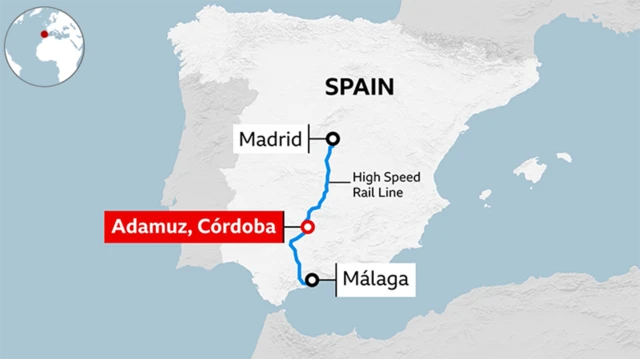
    • The crash happened at 19:45 local time (18:45 GMT) as carriages on a Madrid-bound train derailed and crossed over to the opposite tracks, colliding with an oncoming train near Córdoba, in southern Spain
    • Around 300 people - passengers and staff - were on board the high-speed train operated by Iryo, which derailed. One hundred others were on the other train, operated by state-funded firm Renfe

    What we don't yet know:

    • What caused the train to derail remains unclear. Officials say an investigation has been launched but is not expected to determine what happened for at least a month
    • Spanish Transport Minister Óscar Puente has described the incident as "extremely strange", adding that all the railway experts consulted by the government "are extremely baffled by the accident"
    A map of Spain highlighting a section of the country’s high‑speed rail network. A blue line marks the high‑speed rail route running between Madrid in central Spain and Málaga in the south. A red dot marks Adamuz in the province of Córdoba near the midpoint of the route, where the two trains collided.
  10. Crash survivors urged to contact familiespublished at 09:29 GMT

    The emergency agency in the region of Andalusia has urged any crash survivors, external to contact their families or post on social media that they are alive.

    "For the peace of mind of your family and friends, it might be a good idea to post it on your social media or WhatsApp status—your loved ones will feel relieved, and the lines will stay free for those who need them," the Emergency Agency of Andalusia said in a post on X.

    Miguel Ángel Rodríguez from the Spanish Red Cross tells RNE radio: "The families are going through a situation of great anxiety due to the lack of information. These are very distressing moments."

  11. EU Commission 'ready to help' if neededpublished at 09:20 GMT

    The European Commissioner for Equality, Preparedness and Crisis Management has said the commission's emergency centre is in touch with Spanish authorities and is "ready to help with support if requested".

    In a post on X, Hadja Lahbib also expressed her gratitude to the first responders on the scene and sent her condolences to the victims of the "heartbreaking" train crash.

  12. 'It felt like an earthquake', says passengerpublished at 09:07 GMT

    One passenger who was on one of the trains involved in the crash late on Sunday night says the impact of the collision felt like an "earthquake".

    "I was in the first carriage. There was a moment when it felt like an earthquake and the train had indeed derailed," Spanish RTVE journalist Salvador Jimenez says.

    There were 400 passengers and staff onboard a Madrid-bound train and an oncoming Adamuz train when they collided, according to the rail networks.

    José, a passenger onboard the Madrid-bound train, told public broadcaster Canal Sur: "There were people screaming, calling for doctors."

  13. First images show aftermath of train crashpublished at 09:01 GMT

    Since the sun rose in Spain, we've been reviewing some of the first photos coming into us which show detail of the aftermath of the crash and how responders are assessing the damage.

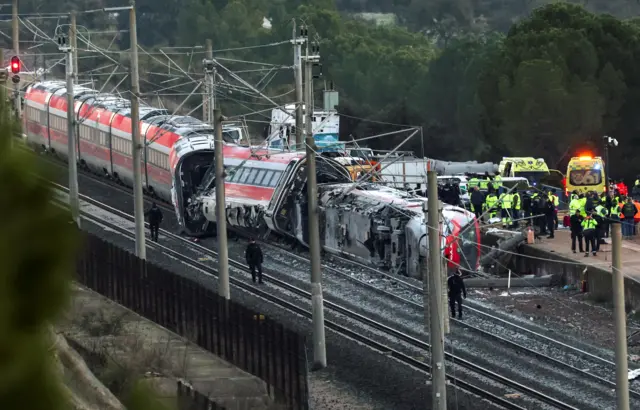
    Wide image shows a train with first two carriages derailed and emergency workers next to it, in AdamuzImage source, Reuters
    Image caption,

    Photos of the crash site show the derailment of the first two carriages, with emergency services assessing the area

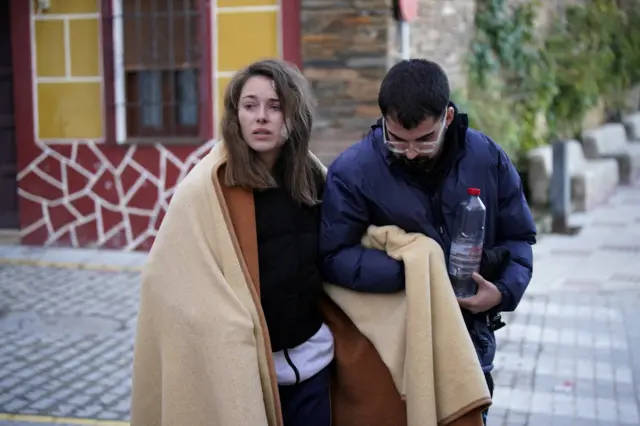
    A woman with a blanket over her shoulders is escorted by a man on a street in CordobaImage source, reute
    Image caption,

    A Citizen Help Centre in Cordoba has been offering services to some of the people caught up in the incident

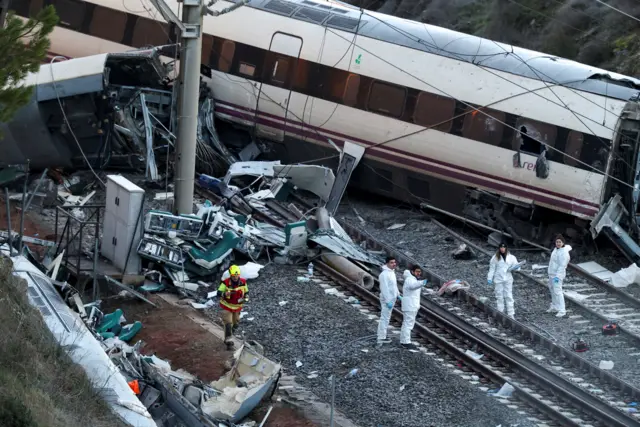
    A closer image shows the derailed carriage with a forensic team in white overalls gathered next to it.Image source, Reuters
    Image caption,

    Forensic teams have also been deployed to begin evaluating the crash

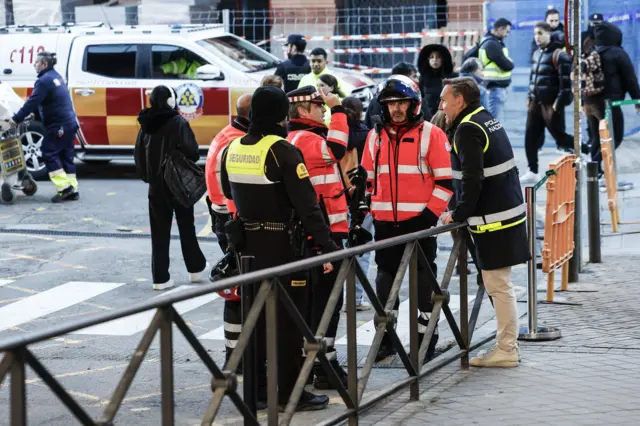
    People in hi vis jackets gather and chat outside a train station with an emergency vehicle behind.Image source, EPA
    Image caption,

    Security officials gathered outside the Atocha train station in Madrid

  14. Watch: Passengers evacuated from inside train after crashpublished at 08:57 GMT

    Videos shared on social media show passengers inside one of the trains involved in the crash as they are evacuated by emergency services staff.

    The footage also shows the outside of some of the carriages, which are visibly damaged.

  15. At least 39 dead and dozens injured in high-speed train crashpublished at 08:50 GMT

    At least 39 people have been killed and dozens more injured in a high-speed train collision in southern Spain, the country's Civil Guard says.

    Carriages on a Madrid-bound train derailed and crossed over to the opposite tracks, colliding with an oncoming train near Córdoba on Sunday evening. Four hundred passengers and staff were onboard both trains.

    Most of those killed and injured were in the front carriages of the second train, which was travelling south from Madrid to Huelva.

    Emergency services treated 122 people, with 48, including five children, still in hospital. Of those, 11 adults and one child are in intensive care.

    Spanish Transport Minister Óscar Puente says the death toll "is not yet final" and an investigation has been launched into the collision, which has been described as the country's worst rail crash in more than a decade.

    We'll bring you the latest lines on the story over the coming hours - stick with us.