Why does Trump want Greenland and what could it mean for Nato?
US President Donald Trump insists his country needs to acquire Greenland for national security reasons and has not ruled out using military force.
His demands have been rejected by Greenland's leaders and by Nato member Denmark, of which the island is a semi-autonomous territory.
This in turn has prompted a diplomatic row, with Trump threatening to use additional trade tariffs against a number of European allies if they do not go along with his plan.
Where is Greenland and why does it matter to Trump?
Greenland - the world's largest island - is located in the Arctic. At around 2.2m sq km (836,330 square miles) it is roughly six times the size of Germany.
It is also the most sparsely populated global territory, with a population of about 56,000 people, mostly indigenous Inuit people.
Its location between North America and the Arctic makes it well placed for early warning systems in the event of missile attacks, and for monitoring vessels in the region.
At the height of the Cold War, the US had plans to station nuclear missiles on the island but abandoned the project over engineering problems and objections by Denmark.
The US has operated Pituffik Space Base - formerly known as Thule Air Base - since World War Two. It currently monitors for missiles.

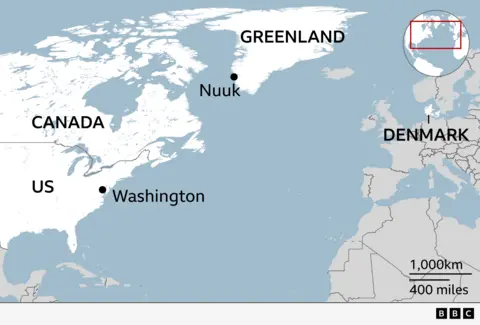
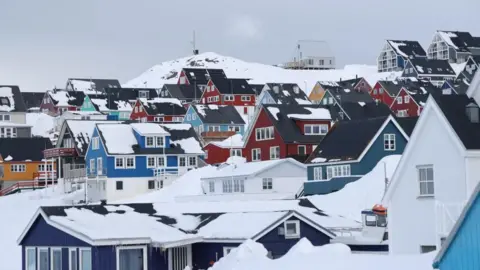
About 80% of Greenland is covered by ice, meaning most people live on the south-western coast around the capital, Nuuk.
Its economy is mainly based on fishing, and it receives large subsidies from the Danish government.
In recent years, there has been increased interest in Greenland's natural resources, including rare earth minerals, uranium and iron. It could also have significant oil and gas reserves.
These resources may become more accessible as global warming leads to the melting of the ice sheet that covers the island.
Valuable mineral resources have been a key focus of Trump elsewhere, including in his dealings with Ukraine. However, the US president has said: "We need Greenland for national security, not minerals."
More than once, he has described the threat he perceives from Russia and China in the region. He wrote in a Truth Social post: "Nato has been telling Denmark, for 20 years, that 'you have to get the Russian threat away from Greenland.' Unfortunately, Denmark has been able to do anything about it. Now it is time, and it will be done!!!"
What has Trump said about the US controlling Greenland?
Trump ramped up calls to take over Greenland following a US military raid on Venezuela, during which its president Nicolás Maduro and his wife were seized and removed to New York.
Greenland's Prime Minister Jens Frederik Nielsen responded by saying "that's enough now", describing the idea of US control as a "fantasy".
But Trump and his allies went on to reiterate their threats. The White House said a number of options were under discussion, including "utilising the US military".
One of his top aides, Stephen Miller, has said "nobody's going to fight the US over the future of Greenland".
But Secretary of State Marco Rubio reportedly told lawmakers that the American plan was to buy rather than invade the island, and the US president himself later appeared to affirm that this was his preferred option.
On 17 January, the US president threatened new tariffs against Denmark, Norway, Sweden, France, Germany, the UK, the Netherlands and Finland if those countries did not support his plan to purchase the island.
Tariffs are taxes on imported goods, so in this case US importers would be required to pay money to the US government each time they buy a product from one of the European nations.
Trump previously made an offer to buy the island in 2019, during his first presidential term, but was told it was not for sale.
He revived his interest shortly after returning to the White House in January 2025.
Vice-President JD Vance visited Greenland in March that year, and gave a speech accusing Denmark of failing to invest enough to protect the territory.
In late 2025, Trump appointed a special envoy to Greenland, Jeff Landry, who has openly spoken about making the island a part of the US.
What have Denmark and other Nato allies said about Greenland's future?
Greenland does not have its own independent military and is not a member of Nato, but is part of the alliance through Denmark.
Trump's stance on the island's future has shocked Copenhagen, which has traditionally enjoyed close relations with Washington.
In response to Trump's tariff threat, Denmark's Prime Minister Mette Frederiksen has said "Europe won't be blackmailed". She and other European leaders issued a joint statement saying Trump's words would "undermine transatlantic relations and risk a dangerous downward spiral".
Her UK counterpart Sir Keir Starmer said the move was "completely wrong", while French President Emmanuel Macron called it "unacceptable".
European nations have repeatedly said that only Denmark and Greenland can decide the territory's future.
On 14 January, Vance and Rubio met the Danish and Greenlandic foreign ministers at the White House for a summit to discuss the future of the territory.
Denmark's foreign minister Lars Lokke Rasmussen described the talks as "frank but constructive," but warned there was a "fundamental disagreement" between the two countries.
Several European countries including France, Sweden and Germany have said they will send military personnel to the territory for exercises and security purposes.
Why does Denmark control Greenland?
Though a part of the continent of North America, Greenland has been controlled by Denmark – nearly 3,000km (1,860 miles) away – for about 300 years.
But the US security interest in Greenland also dates back a long way, and two American administrations before Trump made failed efforts to acquire it.
The island was governed as a colony until the mid-20th Century. For much of this time, it remained isolated and poor.
After Nazi Germany occupied mainland Denmark during World War Two, the US invaded the island, establishing military and radio stations.
 Reuters
After the war, American forces remained in Greenland.
In 1951, a defence agreement with Denmark granted the US a significant role in the defence of the territory, including the right to build and maintain military bases.
In 1953, the island was made part of the Kingdom of Denmark and Greenlanders became Danish citizens.
In 1979, a referendum on home rule gave Greenland control of most policies within the territory, with Denmark retaining control over foreign affairs and defence.
Greenland has a Danish military presence as well as an American one.
What do the people of Greenland think about Trump and his threats?
In response to Trump's threats at the start of 2026, Greenland Prime Minister Nielsen said: "No more pressure. No more insinuations. No more fantasies of annexation.
"We are open to dialogue. We are open to discussions. But this must happen through the proper channels and with respect for international law."
Polling suggests that most Greenlanders back independence from Denmark, but that an overwhelming majority of them also reject the idea of becoming part of the US.
As Trump escalated his language, thousands of people took to the streets in both Greenland and Denmark to protest.