Summary

  1. Read BBC Verify’s Iran protests investigationpublished at 17:24 GMT 14 January

    Aisha Sembhi
    BBC Verify Live journalist

    We’re closing BBC Verify Live’s coverage for the day, but our new investigation into the anti-government protests in Iran has just been published.

    Read our analysis of what videos emerging from a mortuary in Tehran show about the brutality of the government’s crackdown.

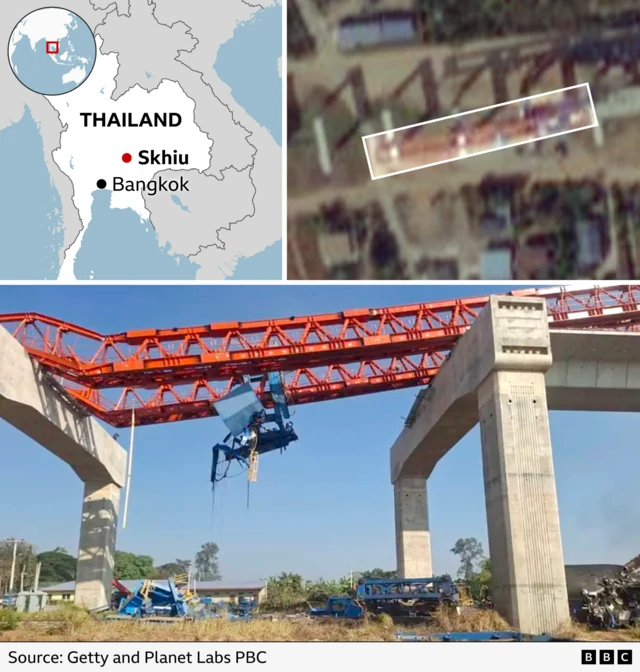
    Here on BBC Verify Live we’ve covered a rail crash in Thailand that killed at least 32 people by checking satellite imagery to verify the exact location of the incident and identify the crane that collapsed on to a moving train.

    We also analysed aftermath images following recent strikes on a postal depot in Ukraine’s Kharkiv region and a block of flats in the Russian city of Rostov-on-Don.

    Plus our fact-check team has been looking at UK and US stories, including:

    • How many times the UK government has U-turned, a key talking point at this week’s Prime Minister’s Questions
    • Whether the decision to commission more offshore wind power will affect British household energy bills
    • Examined President Donald Trump's recent claim that US economic growth is "at an all-time high"

    BBC Verify Live will be back tomorrow.

    BBC Verify banner
  2. Fact-checking government’s new ‘Secure Borders UK’ TikTok accountpublished at 17:02 GMT 14 January

    Lucy Gilder
    BBC Verify journalist

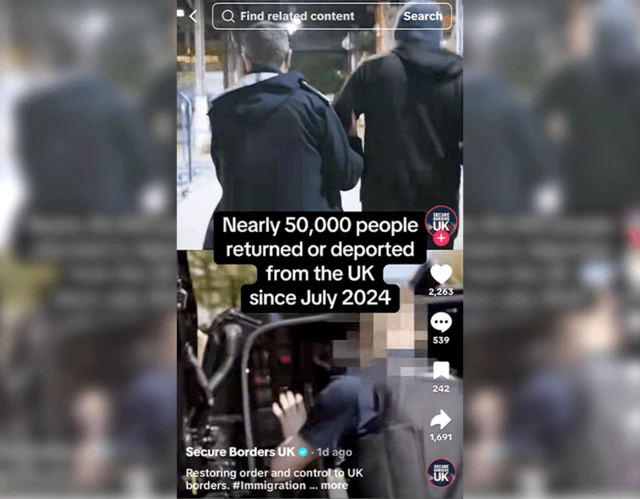
    On Tuesday the Home Office launched a new TikTok account called “Secure Borders UK”.

    It has posted four short videos aiming to showcase the government’s record on illegal immigration since winning the election last year.

    In one video, over footage of immigration raids and people being escorted by officers and put on to aircraft, an on-screen caption states “nearly 50,000 people returned or deported since July 2024”.

    The latest official figures show the government recorded 48,560 returns, external between July 2024 and October 2025, but only a quarter of these (12,529) were classed as “enforced” returns - where an individual might be escorted on to a flight (as shown in the video) to make sure they leave the UK.

    The majority of the returns were voluntary. This can involve government assistance but in some cases people leave the UK independently without the government's knowledge at the time.

    The 50,000 figure includes returns of foreign criminals (some of which are counted as a “deportation”), failed asylum seekers, and other people with no right to remain in the UK.

    A screen grab from the UK Home Office's TikTok video where it makes the claim "nearly 50,000 people returned or deported since July 2024"Image source, TikTok/@Secure Borders UK
  3. Verified videos show protests in 28 Iranian provincespublished at 16:42 GMT 14 January

    Shayan Sardarizadeh and Daniel Wainwright
    BBC Verify

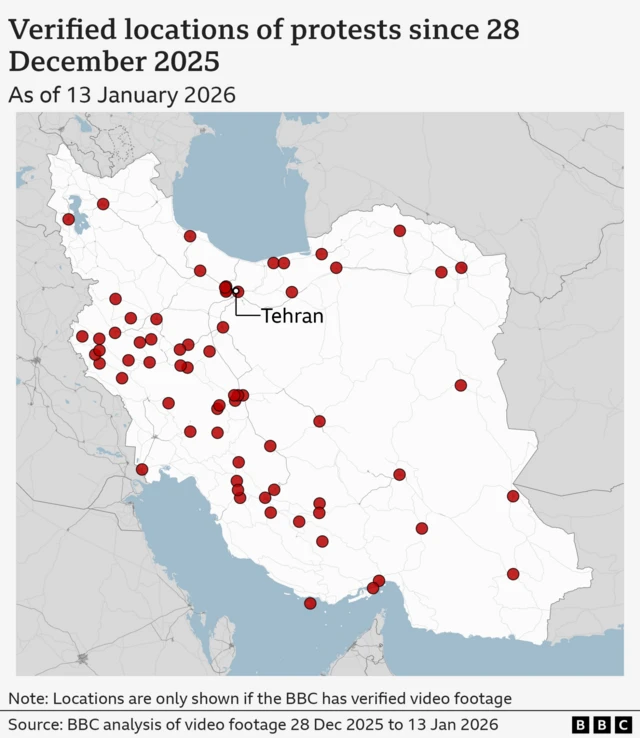
    Since the outbreak of anti-government protests in Iran in late December, BBC Verify and BBC Persian have verified more than 200 videos of demonstrations in 68 towns and cities across the country.

    Based on our map of verified footage, we have evidence of protests taking place in 28 of Iran’s 31 provinces, showing the scale and geographical spread of the latest wave of unrest.

    Our tally is almost certainly an undercount, as there are dozens of videos described as showing other locations for which we have not been able to confirm the exact location or time.

    A map of Iran has 68 red dots with locations of protests across the country, from video footage analysed by the BBC from 28 December 2025 to 13 January 2026. The capital Tehran is annotated. There is at least one dot in 28 out of Iran’s 31 provinces.

    The flow of videos coming out of Iran has slowed to a trickle since Thursday, when the authorities imposed a near total internet shutdown.

    But a few videos have come through, including one showing clashes between protesters and security forces in the north-western city of Urmia in West Azerbaijan province.

    The clip, which is the most recent verified piece of footage, is also the first we’ve confirmed from the city or province.

    The ongoing blackout has made it extremely difficult to confirm the dates of some of the videos, as it may now take several days after a demonstration has taken place before footage of it first appears online.

  4. Watch: Will more offshore windpower drive up energy bills?published at 16:12 GMT 14 January

    Earlier, we looked into the UK government's decision to commission more offshore wind power - which ministers say will be good for households but the Conservatives argue will push up energy bills.

    BBC Verify’s policy and analysis correspondent Ben Chu has been examining the numbers.

    Media caption,

    Watch: Will more offshore windpower drive up energy bills?

  5. Fact-checking Trump’s economy speechpublished at 15:12 GMT 14 January

    Tom Edgington
    BBC Verify senior journalist

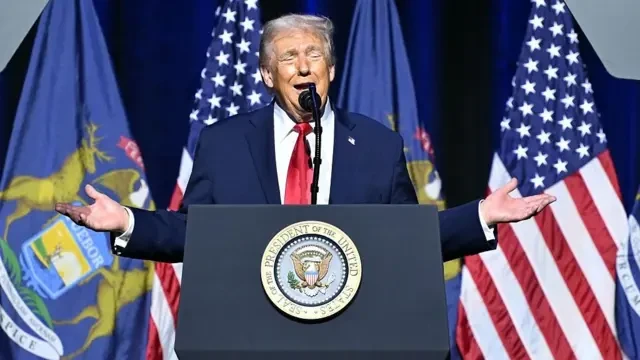
    US President Donald Trump speaks at the Detroit Economic Club in Detroit, Michigan, 13 January 2026Image source, Getty Images

    President Donald Trump gave a speech yesterday focusing on the US economy and what he sees as his administration’s key achievements over the past 12 months, including claiming that “inflation is defeated”.

    That is despite newly-released official figures, external showing prices rose by 2.7% in the 12 months ending December, unchanged from the previous month. While annual inflation is down from 3% when Trump took office last January, it remains above the 2% target set by the Federal Reserve, the US central bank.

    He also claimed that former President Joe Biden oversaw “the worst inflation in the history of our country”. Prices did rise significantly during Biden's first two years in office, peaking at 9.1% in June 2022 shortly after Russia's full-scale invasion of Ukraine - which contributed to inflation in other countries.

    However, this was not the “worst” on record in the US. This occurred in 1920, when inflation reached 23.7%. It was also higher at points in the 1970s and 1980s.

    Trump also boasted that "growth is exploding” and “at all-time high”.

    It is true the US economy has picked up, according to the most recent data. In the three months to September 2025, the economy grew at an annual rate of 4.3%, external, up from 3.8% in the second quarter. This followed a contraction of 0.6% in the three months to March.

    However, while the latest quarter was better than analysts expected and marked the strongest annualised growth in two years, it was not an all-time high.

    Trump also spoke about falling petrol prices during his speech: a claim we looked at yesterday.

  6. Get involved with BBC Verifypublished at 14:57 GMT 14 January

    Rob Corp
    BBC Verify Live editor

    We’re keen to hear what you think the BBC Verify team should be looking into.

    We're interested in investigating claims you may've seen online in your social feeds. We're also keen to know if you've think an image may have been made using artificial intelligence to spread disinformation.

    You can also get in touch with BBC Verify if you've got a question about how we verify video posted online or work with satellite imagery.

    You can send your suggestions to the team here.

    BBC Verify banner
  7. Will the latest UK wind power auction push up household energy bills?published at 14:29 GMT 14 January

    Ben Chu
    BBC Verify policy and analysis correspondent

    The UK government has awarded contracts to generate more offshore wind power in its latest Contracts for Difference (CFD) auction, which offers wind farm operators a guaranteed price for the electricity they produce and feed into the national grid.

    The government insists this wind power auction is a good deal for bill-payers, but the Conservatives say it will push up household energy costs.

    Whether these latest CFDs push up bills or not depends on whether the wholesale price of electricity is higher or lower than the price for power guaranteed in this auction, known as the strike price, in future years.

    The agreed strike price for these latest contracts is £91 per megawatt hour (MWh) of electricity generated - up from £82/MWh at last year’s auction.

    Some analysts argued before this auction that any strike price below £94/MWh would likely help bring bills down. , external

    But others argued the strike price needed to be below £80/MWh to push down bills and a strike price above this level would likely increase bills., external

    There's no definitive answer as to what will happen following today’s auction because it depends to a considerable degree on what happens to future wholesale gas prices as these have a big impact on wholesale electricity prices in Britain.

  8. How many times has the UK government U-turned?published at 13:38 GMT 14 January

    Anthony Reuben
    BBC Verify senior journalist

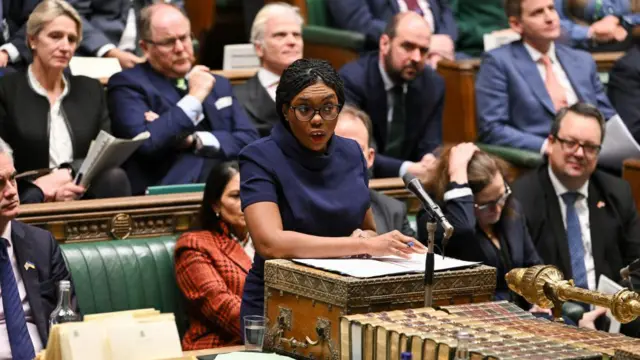
    Conservative Party leader Kemi Badenoch at Prime Minister's QuestionsImage source, PA Media

    At Prime Minister’s Questions earlier Conservative Party leader Kemi Badenoch welcomed the announcement that digital ID cards will not be made compulsory for workers in the UK, citing it as PM Sir Keir Starmer’s “latest U-turn”.

    News organisations including Sky News, the Daily Express and Politico have come up with their own lists of the government’s U-turns - most of them contain these as examples of when ministers have reversed course:

  9. Residential building damaged during reported drone attack in Russian citypublished at 13:04 GMT 14 January

    Paul Brown
    BBC Verify senior journalist

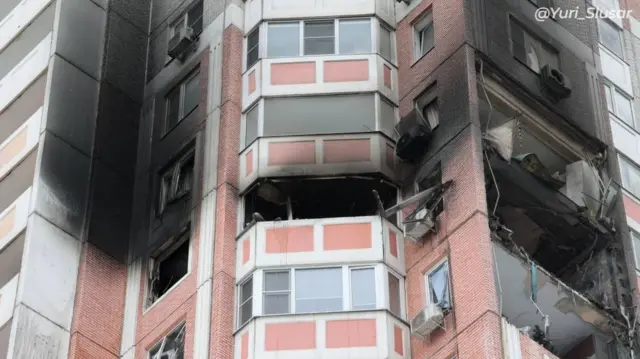
    Extensive smoke and fire damage can be seen in this picture showing the upper storeys of the block in RostovImage source, Yuriy Slusar

    One person has died and four more have been injured in a reported Ukrainian drone attack on the southern Russian city of Rostov-on-Don, according to the regional governor.

    Footage we've reviewed shows a fire in a high-rise residential building and a nearby industrial site in the west of the city.

    Close-up images of the high-rise show fire and smoke coming from the upper three storeys. The image at the top of this post shows extensive damage to part of the block.

    Pro-Ukrainian social media channels have claimed the building was struck by a Russian air defence missile rather than a drone. Without footage showing the moment of impact we are unable to confirm this.

    The governor of Rostov region, Yuriy Slusar, said on Telegram that one man was killed in the strike, while his wife and child were able to escape.

    He added that a fire in an industrial area of the city had been extinguished and another had been brought under control.

  10. Winners and losers from the Scottish budgetpublished at 12:37 GMT 14 January

    Phil Sim
    BBC Scotland political correspondent

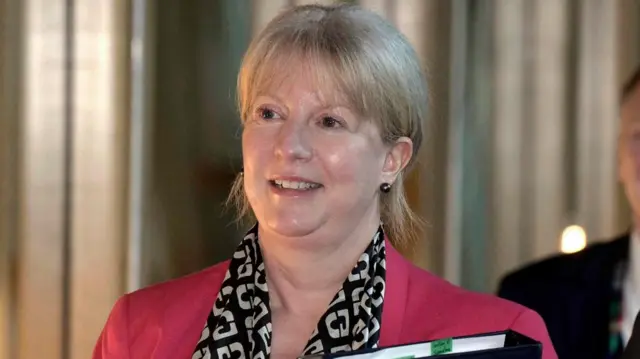
    Scottish Finance MInister Shona RobisonImage source, PA Media
    Image caption,

    The budget was delivered in the Scottish Parliament by Finance Minister Shona Robison

    We’ve been working with BBC Verify to analyse the Scottish budget proposals set out at Holyrood yesterday.

    The key measures were chiefly aimed at families - like plans to expand the Scottish Child Payment and offer free breakfast clubs in every primary school - although neither policy will take effect until 2027.

    There is also an extra £70m for colleges after years of real-terms cuts and extra business rates reliefs for companies worried about a looming revaluation of their property taxes.

    There were eye-catching plans for a “mansion tax” - new council tax bands to target houses worth more than £1m - although these will only raise £14m for a total budget of £68bn.

    And there have been tweaks to the devolved system of income tax,which includes six different bands ranging from 19% to 48%.

    Changes to thresholds mean that 55% of Scots should end up paying less tax than they would if they lived in the rest of the UK.

    However the difference is at most £40, while higher earners will pay significantly more - someone earning £50,000 will pay almost £1,500 more in Scotland than they would in the other UK nations.

  11. Four dead after postal depot struck in Kharkivpublished at 12:04 GMT 14 January

    Sherie Ryder and Fridon Kiria
    BBC Verify and BBC Monitoring

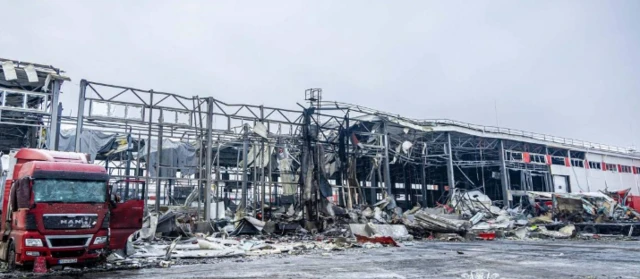
    A heavily damaged postal depot building and lorry, there is burn marks, rubble strewn around and part of the building has lost much of its structure with just metal frames left standingImage source, State Emergency Service of Ukraine

    We’ve been looking into posts on social media showing the aftermath of a reported Russian strike on a postal depot in the Kharkiv region of Ukraine yesterday.

    Regional head Oleh Syniehubov has confirmed four people were killed in the attack in the suburbs of Kharkiv city.

    The images show several partially destroyed buildings and debris strewn around, as well as clearly visible postal lorries with their windscreens smashed in.

    We were able to match part of a main building, painted red and white, to images of the same depot after it was also hit two years ago.

    Looking at the location of the depot on Google Maps, one photo shows the long length of loading bays, and panning around, we can see that it is situated across the main road from the Korotych aerodrome.

  12. Confirming Uganda’s internet shutdown ahead of electionspublished at 11:21 GMT 14 January

    Peter Mwai
    BBC Verify senior journalist, reporting from Nairobi, Kenya

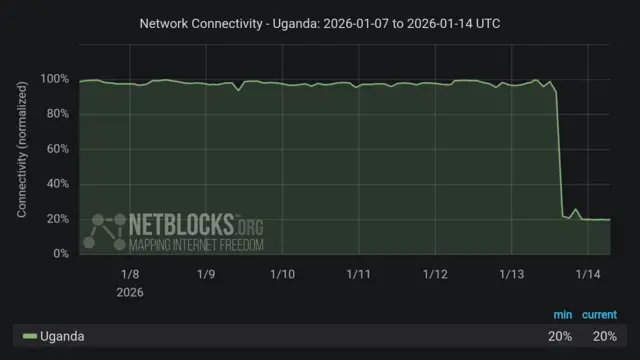
    A graphic from Netblocks showing how internet connectivity in Uganda dropped dramatically on between Tuesday and WednesdayImage source, Netblocks.org

    Internet monitoring organisation Netblocks has confirmed major disruption to internet connectivity in Uganda ahead of general elections on Thursday.

    Netblocks recorded a drop off of network connectivity on Tuesday evening to about 20%.

    This coincides with an order by Uganda’s communications commission to internet service providers to suspend public access to the internet.

    The commission has said is to “mitigate the rapid spread of online misinformation, disinformation, electoral fraud” and prevent incitement of violence.

    But Netblocks warns that “far from halting misinformation, the measure is likely to limit transparency and increase the risk of vote fraud”.

    Restriction of the internet makes it challenging for people to post information, videos and images about events online, making it harder for journalists and election monitors to verify and report.

    During Uganda’s last election in 2021, which saw widespread protests with dozens killed, the internet was cut for at least a week.

    Thursday’s presidential election is a repeat of the 2021 contest between President Yoweri Museveni, seeking his seventh term of elected office, and former pop star Bobi Wine, whose real name is Robert Kyagulanyi.

  13. Watch: How an internet blackout impacts our Iran protest reportingpublished at 10:53 GMT 14 January

    Aisha Sembhi
    BBC Verify Live video journalist

    Our verification team is monitoring the situation in Iran, which has been rocked by anti-government demonstrations for more than two weeks and as many as 2,400 protesters have reportedly been killed.

    We typically use social media videos and eyewitness accounts to build a picture of what’s happening on the ground, but a government-imposed internet blackout has prevented Iranians from posting new material in recent days.

    BBC Verify's Shayan Sardarizadeh explains how this near-total shutdown impacts our reporting of what's happening on the ground:

    Media caption,

    BBC Verify's Shayan Sardarizadeh on how an internet blackout impacts Iran protest coverage

  14. Satellite image shows Thailand crane before train crashpublished at 10:37 GMT 14 January

    Paul Brown
    BBC Verify senior journalist

    We've been looking at the aftermath of a rail crash in Thailand which has killed at least 28 people, caused by a crane being used to construct an overpass falling onto a train passing beneath it.

    Footage from the scene in central Thailand shows the mangled train wreckage and part of a specialised crane called a launching gantry, used in the construction of bridges, overpasses and viaducts, has collapsed.

    The imagery also shows that the incident occurred close to a level crossing, which we were able to identify in the town of Skhiu in Nakhon Ratchasima province.

    Satellite imagery captured by Planet on 5 January shows the crane at around the same spot. A similar-looking red crane visible around half a mile (1km) to the east in a Google Street View image taken in March last year.

    The overpass was being built as part of a high-speed rail project connecting Thailand and China.

    The train was travelling along tracks running beneath the structure, en-route to Ubon Ratchathani province from Bangkok. Rail authorities say that 195 people were on board, with 80 people reported injured.

    A BBC graphic showing (from top left) the location of the crash on a map of Thailand; satellite imagery of the red structure and work on the overpass; an agency pic of the aftermath
  15. Wednesday at BBC Verifypublished at 10:27 GMT 14 January

    Rob Corp
    BBC Verify Live editor

    Good morning.

    We’ve verified images showing the scene of today’s train crash in Thailand which has killed at least 28 people after a crane collapsed onto a carriage. By comparing footage posted online with available satellite imagery our team has confirmed the incident happened at a place where work on a high-speed rail line was under way.

    BBC Verify is continuing to monitor what is happening in Iran following the recent anti-government protests. Despite a country-wide internet blackout we are checking for new material being shared by Iranians who are finding alternative ways to get online such as satellite broadband.

    Later we’ll bring you more on a BBC Verify investigation into the Iran protests - we’ve been examining videos from the main mortuary in Tehran that shows the bodies of dozens of people who were killed.

    Away from those stories our fact-check team will be across Prime Minister’s Questions in the House of Commons at midday. We’ve also got confirmation of an internet blackout across Uganda ahead of tomorrow’s presidential elections.

    BBC Verify banner