'Somebody perhaps decided to test us': How a Norwegian weather rocket almost sparked a nuclear war

 Alamy
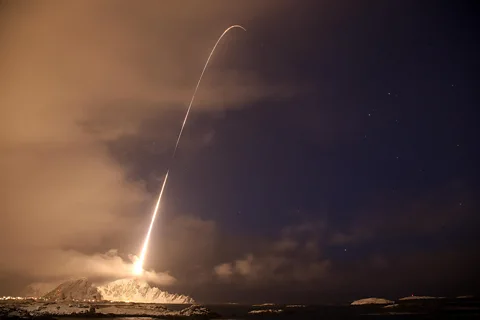
AlamyA Norwegian rocket launched on 25 January 1995 in order to study the Northern Lights, was mistaken by Russia for an incoming nuclear missile on a direct course to Moscow.
For just over an hour on a freezing winter's day, the world had a chilling brush with the worst of Cold War nightmares. On an unremarkable Wednesday afternoon, military technicians on shift at radar stations across northern Russia spotted an ominous blip on their screens. A rocket had been launched somewhere off Norway's coast and was rising fast. Where was it going and was it a threat? After all, most assumed such nuclear tensions had evaporated when the Berlin Wall came down.
For those monitoring the skies, the implications were dreadful. They knew that one missile fired from a US submarine in those waters could deliver eight nuclear warheads to Moscow within 15 minutes. The message was passed urgently up the chain of command to Russian President Boris Yeltsin.
He became the first world leader to activate a "nuclear briefcase", a case that contains the instructions and technology for detonating nuclear bombs. Since the end of World War Two, nuclear-armed states have operated a policy of deterrence, based on the idea that if warring states were to launch major nuclear strikes it would lead to mutually assured destruction. In that tense moment, Yeltsin and his advisers had to decide urgently whether to retaliate.
As we all now know, this alarming chain of events did not end in catastrophe. For all the heightened tension, the story ended up as a light-hearted item at the end of that evening's late news programme, complete with Tom Lehrer's blackly comic song We Will All Go Together When We Go ("… all suffused with an incandescent glow").
The BBC's Newsnight presenter Jeremy Paxman noted: "Before we go, we should report that nuclear war did not break out today, despite the best efforts of a Russian news agency. At 13:46, reports began coming in quoting the Moscow news agency Interfax that Russia had shot down an incoming missile. Reporters, thinking they were about to have ringside seats for Armageddon, immediately called the Ministry of Defence. A stirred but unshaken spokesman boldly asserted: 'I am confident that the British have not fired any missiles at Russia.'" A Pentagon spokesperson was none the wiser, saying, "All we have is reports of reports."
World currency markets wobbled, while politicians, military chiefs and journalists spent a frantic hour scrambling for information. At 14:52 GMT, the people who were aware of the potential crisis could breathe again. Interfax corrected its report to say that – although Russia's early warning system had registered the launch of a missile – the rocket had landed in Norwegian territory.
Later, a defence official in Norway confirmed the launch was made in peace. It had been part of a routine scientific research programme at a civilian rocket range and was aimed at gathering information about the Northern Lights, the unique weather phenomenon otherwise known as the aurora borealis. The rocket landed as planned in the sea near the remote Arctic island of Spitzbergen, well short of Russian air space. Hours after the report was known to be false, unnamed Russian defence sources told Interfax it was "too soon to tell" if the launch was intended to test their early-warning radar system.
Russia had been sensitive about its air defence capabilities since 1987, when West German teenager Mathias Rust managed to fly more than 500 miles (750km) through every Soviet defensive shield in a single-engine plane to land at the gates of the Kremlin. By now the Cold War was over, but this was a sign that some Russian officials remained jittery about a nuclear threat.
More like this:
• How the 1973 oil crisis forced Nixon to rethink time
• How the US dropped nuclear bombs on Spain in 1966
• How fascist 'Lord Haw-Haw' was tried for treason
"I was terrified when I heard about the attention our routine firing got," said Norwegian scientist Kolbjørn Adolfsen, who was in a meeting when the panicked telephone calls started coming in. What was even stranger was that weeks earlier, Norway had already told Moscow about the planned launch. Mr Adolfsen suggested the Russians might have reacted because it was the first time that an aurora borealis rocket had gone up at such a high ballistic trajectory, reaching an altitude of 908 miles. However, he said it should not have come as a surprise. "A message was sent through the foreign ministry on 14 December to all nations concerned that we would be doing the firing," he said. Yet somehow, that warning never reached the right desks. It was a sobering reminder of how a single missed message could have potentially catastrophic consequences.
 Getty Images
Since the dawn of the nuclear age, there have been more near misses than one might like to dwell on. It's not just major events such as the 1962 Cuban missile crisis, which was probably the nearest the Cold War came to breaking into an all-out nuclear war between the US and the Soviet Union. In 2020, BBC Future reported on how false alarms have been triggered by everything from migrating swans and the Moon to computer glitches and space weather. In 1958, a plane accidentally dropped a nuclear bomb into a family's garden, thankfully killing only their chickens. In 1966, two US military planes crashed over a remote Spanish village; one of them was carrying four nuclear weapons. As recently as 2010, the US Air Force briefly lost contact with 50 missiles, leaving no way to detect or halt an automatic launch.
Dangerous moment
Many in Russia at the time dismissed Yeltsin's announcement that he had used the nuclear briefcase for the first time as bravado, intended to divert attention from the unfolding Chechen war. "I indeed yesterday used for the first time my 'black' suitcase with the button which is always carried with me," he told Interfax news agency the day after. "Somebody perhaps decided to test us, because the media is saying all the time that our army is weak," he added.
Newsnight's report on the Norwegian rocket scare may have been flippant, but opinions vary on the magnitude of the incident. For one former CIA official, it was "the single most dangerous moment of the nuclear missile age". Military advisor Peter Pry wrote: "Never before had a leader of any nuclear power opened his equivalent of the Russian 'nuclear briefcase' in earnest, in a situation where a real threat was perceived, and where an immediate decision to launch Armageddon was possible."
In History
In History is a series which uses the BBC's unique audio and video archive to explore historical events that still resonate today. Sign up to the accompanying weekly newsletter.
However, UN nuclear disarmament researcher Pavel Podvig said: "If I were to rank these cases… I would probably give it three out of 10. There were far more serious incidents during the Cold War." He even suggested that the nuclear briefcase scenario might have been staged for Yeltsin the day after. Russian nuclear expert Vladimir Dvorkin said the Norwegian alert had posted no danger, "none at all". He told the Washington Post in 1998: "Even when a warning system gives you a signal about a massive attack, no one is ever going to make a decision, even an irrational leader alarmed that one missile has been fired. I think this is an empty alarm."
Five days after the incident, BBC radio bulletins reported that Russia had blamed the alert on "a misunderstanding" which must not be repeated. A foreign ministry spokesman said the Norwegians had acted according to normal procedure and there should be no ill will towards them. While disaster had been averted, it remains alarming that a harmless meteorological rocket could cause such a panic.
--
For more stories and never-before-published radio scripts to your inbox, sign up to the In History newsletter, while The Essential List delivers a handpicked selection of features and insights twice a week.
For more Culture stories from the BBC, follow us on Facebook and Instagram.